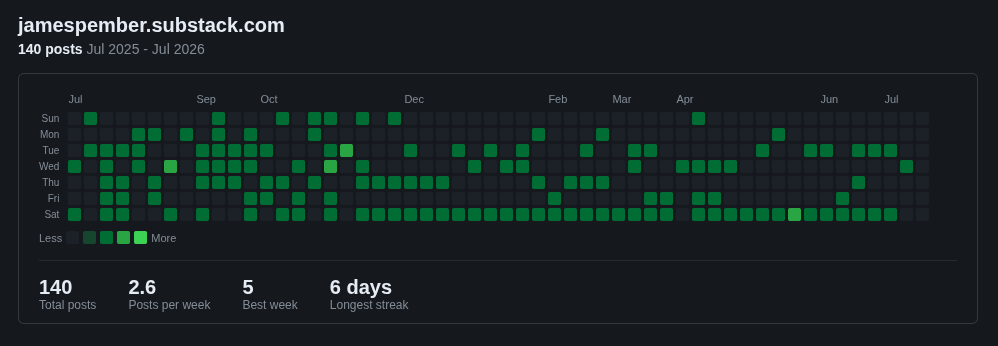
I’ve now been writing on this Substack for 12 months. I’ve posted 140 times at an average of 2.6 times a week. 99 of these have been “essays” or posts, and 41 have been reading lists of links. This post, which you are reading right now, is my 100th “article”.
Reflections
“To write is to think” is a total cliche, but it feels real nonetheless. Arguments and ideas that sound crisp in my head suddenly fall apart when I try to put them onto the page.
Reading inspires writing, which in turn inspires more reading. It sounds like an obvious point, but I don’t think it’s a coincidence that in the same year I started writing a lot, I’ve started reading a lot more too.
Writing regularly has made me far less precious about posting.
The “best” ideas seem to arrive while writing, not before.
Writing frequently has helped me recognise which ideas reoccur in my head as part of my internal dialogue. Which ideas are sticky. Creation versus consumption. Ambition versus efficiency. Open versus closed technology. Making things versus criticising them. Barriers and gatekeepers. Apparently I’ve been writing the same five posts over and over again!
I genuinely (promise!) don’t think much about how many people read my posts, but “dark followers” are a very real phenomenon. Most posts get almost no likes or visible attention, yet I receive DMs every week from people who say they enjoy them.
Lastly, a blog is a surprisingly useful personal scratchpad and idea archive. Looking back, I can see ideas appearing in rough form, disappearing, then returning months later as something much more developed.
Some of my favourite posts
These aren’t necessarily the most popular posts. They’re the ones that, reading everything back, feel the most well-written, personal or intellectually interesting.
Cheap turpentine

“When art critics get together they talk about Form and Structure and Meaning. When artists get together they talk about where you can buy cheap turpentine” - Pablo Picasso.
Blunt instrument

An interesting, albeit utterly predictable side effect of removing all feed-based media apps (yes, even Substack) from your phone, is that you find yourself using that phone less.
The new needs friends

“In many ways, the work of a critic is easy. We risk very little, yet enjoy a position of those who offer up their work and their selves to our judgement. We thrive on negative criticism."
Taking advantage of your character

There was a lovely article in The Australian Weekend Magazine a few weeks ago, an interview with “John and Jenny”, two 90-year-old Australians sharing their life stories and a little wisdom along the way. I loved this idea from Jenny, on taking advantage of your character
Brain rot is over, if we want it

My 6 year old’s latest fascination is writing short stories in her notebook. She’s learnt the “5 elements of plot” at school, and is obsessed with putting this newfound knowledge into practice.
Loom vs Linear: A tale of two AI-cities

“Because of rapidly advancing capabilities, agents will be brought into nearly all areas of work. Agents will be deployed to review every contract that gets written, handle the front lines of most customer support cases, audit every company’s financials, comb through every piece of medical research for drug discovery, generate nearly all code that ever …
SaaS, the laws of gravity & context-as-a-service

All SaaS companies worth their salt (Posthog, Basecamp, Intercom etc) are racing to launch CLIs and adopt a more “headless composability” approach, where agents can do more and more of the heavy-lifting work inside these products, simply by interacting with APIs, CLIs, and SDKs.
Brute force

I’ve been seeing a lot of posts online recently about why we are 3.5 years into the ChatGPT era, yet half the knowledge work sector is still unsure if AI is actually a net-positive for their personal productivity.
Are you prolific or productive?

“He set himself to learn many things, and when he had begun them, gave them up”.