Brute force

I’ve been seeing a lot of posts online recently about why we are 3.5 years into the ChatGPT era, yet half the knowledge work sector is still unsure if AI is actually a net-positive for their personal productivity.
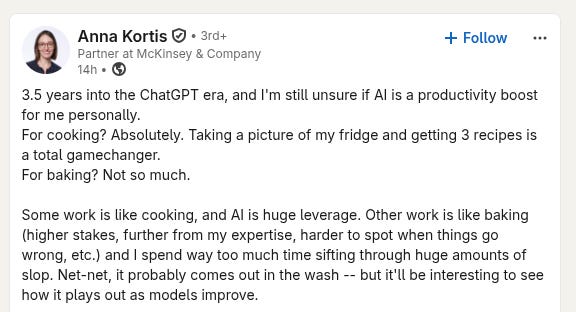
In this post above, Anna raises an interesting analogy. Cooking vs baking. She noted that AI right now is incredible for cooking, taking a picture of your fridge, applying some human judgment, and dynamically riffing on a recipe. But for baking? Not so much. Baking is high-stakes! Once the muffin is in the oven, you can’t go back and change anything. Her argument was, when things go wrong in high-stakes knowledge work, you end up spending more time sifting through AI-generated slop trying to fix it than you would have spent just doing the work yourself.
It’s a smart framing, and on the surface makes a lot of sense. But it also perfectly highlights the fundamental gap between the “chatbot” era we are leaving behind, and the “agentic” world we are moving into.
When we use a chatbot (like ChatGPT or Gemini), we are stuck in a one-shot paradigm. You write a prompt, hit enter, and you pray the model bakes the perfect muffin on the first try. If it doesn’t, the burden of iteration (i.e. fixing it) falls entirely on you. We’ve all experienced the pain of prompting and prompting, and getting worse and worse results.
The opposite of a perfect one-shot is raw, brute-force iteration. Trying, failing, tweaking, and trying again until it’s right. But to understand why we haven’t built systems this way until now, we have to completely re-frame our relationship with the conceptual merit of accuracy, efficiency, and quality.
We are programmed to hate inefficiency. If a human baker ruined five batches of muffins just to figure out the right recipe for the sixth, we’d call them incompetent (not to mention extremely inefficient).
Once you start thinking about it, you see this cultural meme everywhere:
“Measure twice, cut once”
“If a job is worth doing, it’s worth doing well”
“Slow is smooth, and smooth is fast”
“Do it right, or don’t do it at all”
Every piece of cultural wisdom we’ve inherited as a species is designed to minimise waste because, for humans, failure is was expensive. Generating multiple incorrect, broken versions of a task (on purpose) just to find the single right one feels instinctively like “slop” and waste to us.
But today compute is cheap, humans are expensive, and agents aren’t humans.
An agentic system doesn’t need to get it right on the first try. The agent’s job is to embrace the exact brute-force trial and error that we find so distasteful, and handle it entirely in the background. Whilst you sleep, or do something else, autonomously.
To lean into the baking analogy: an agent can very cheaply bake 5 versions of the muffin, run an automated validation loop on the results, quietly throw out the four failures, and only serve you the one that actually worked. It ruins five batches of muffins so you don’t have to.
This is the structural shift we are all navigating right now. We are moving away from AI as a synchronous, real-time conversational partner, and toward AI as an asynchronous, autonomous machine. It’s a weird, exciting and difficult journey.
AI won’t make us more productive if we rely on a perfect one-shot prompt every time. AI will (only) revolutionise knowledge work if it’s allowed to brute-force the trial and error while we sleep. If you can hand over a high-stakes baking problem at 5 PM, and by the time you wake up, the agent has quietly burned through the slop, course-corrected, and left the perfect result waiting for you.
I get it, it feels instinctively wrong to rely on brute force. It rubs up against all of our our ingrained cultural instincts. But when the friction of iteration drops to zero, throwing compute at the wall until it sticks isn’t slop, it’s just smart.