I built an internal agent orchestration platform for my company. Here's what I learned.

There are two interesting things going on in enterprise AI right now:
Whilst the industry is obsessed with agents and agentic-everything, so much of internal enterprise AI adoption is still just LLM chatbots. Engineers are so far ahead of the curve here on what’s possible with coding agents, but almost none of that productivity has trickled down to Marketing, HR or Finance.
Almost all AI usage today is single-player. Productivity gains are almost always made in “private spaces”, the Gemini web app or the Claude Code CLI, but I can’t see what you’re talking to Gemini about. I see the output and the artifacts, but I don’t know how you got there. There is still no consensus on what “mission-control” for agents looks like today inside a company. The closest we have is Claude Cowork.
As a weekend project, I decided to build a prototype of how I’d think about solving these problems. I call it Quarterdeck.
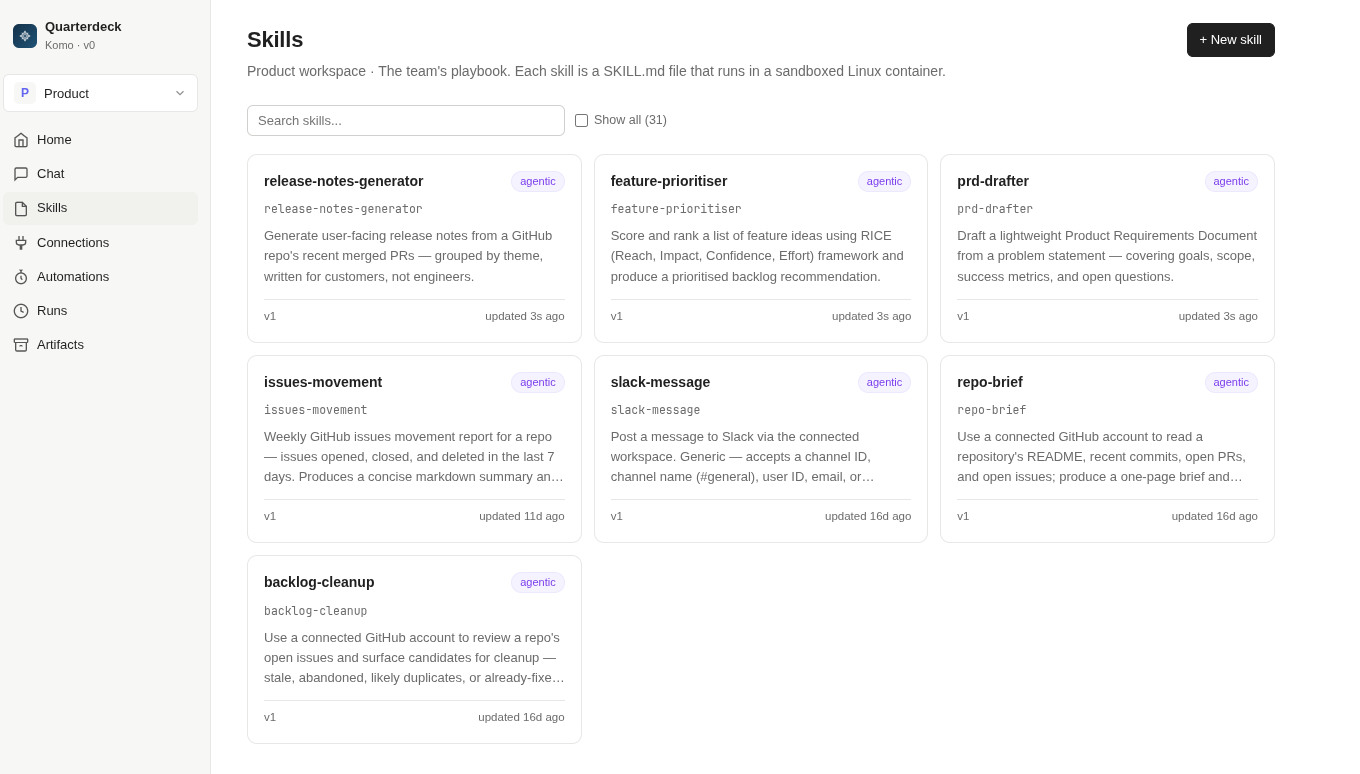
What is Quarterdeck?
One platform for teams in a company to define their processes as Skills.
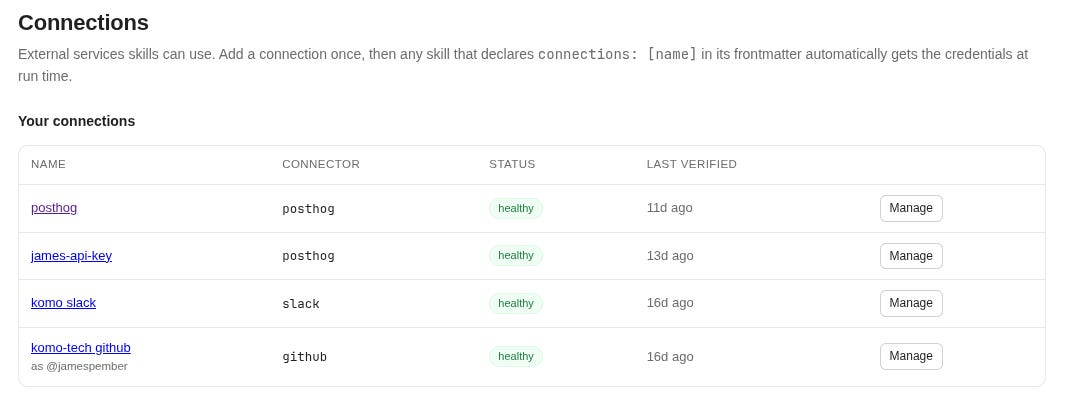
A way to wire up Connected Apps and integrations (Slack, Posthog, Github etc).
Agents that can read Skills and execute code in a safe and secure isolated sandbox.
Centralised Artifacts so agents can write and read files outside of their sandbox.
An Automations platform to orchestrate all of this (triggers, crons, scheduling).
How does it work?
First, a user defines a Skill. A skill can be any recurring routine or process. The skill has a detailed set of instructions for how a task or process should be completed, what order steps should be completed in, which tools are required and what output or artifact the skill should generate.
A simple example is a Skill could be “Weekly Product Usage Reporting”. The skill could tell the agent to go look at the usage stats in Posthog or Amplitude, reason about the most important stats and trends, compile it into a PDF and send it via Slack every Monday morning to the relevant channels.
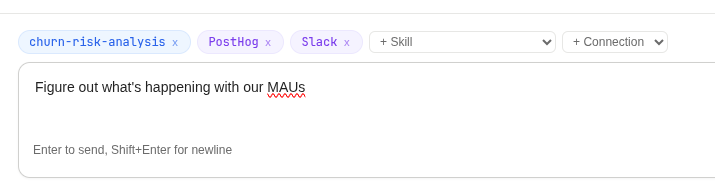
Skills can be invoked explicitly (i.e. the user tells the agent to use it via Chat), but agents can also figure out which Skills or Tools should be used to complete a task too.
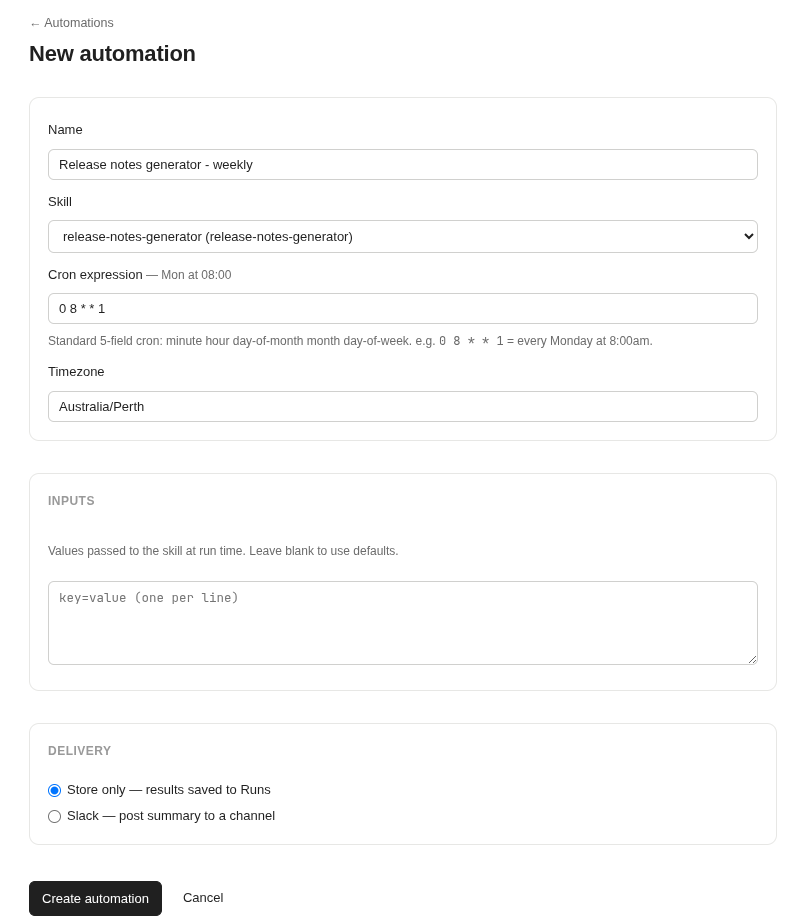
Users can setup an Automation which trigger the agent to execute a task or skill, either based on a Trigger or Schedule. “Do this every Monday at 9am” vs “when triggered via API endpoint”.
Each team has their own Workspace, where they can define their own Connected Apps and Skills.
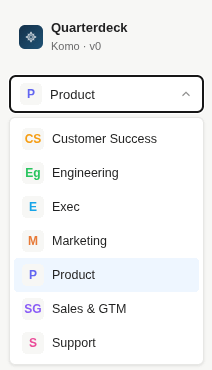
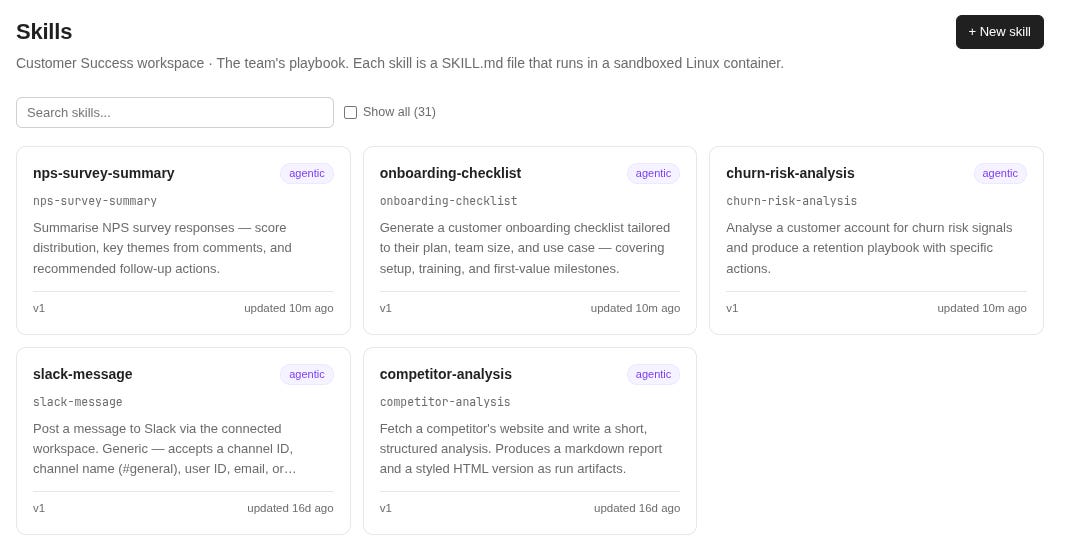
A skill is just a Markdown file.
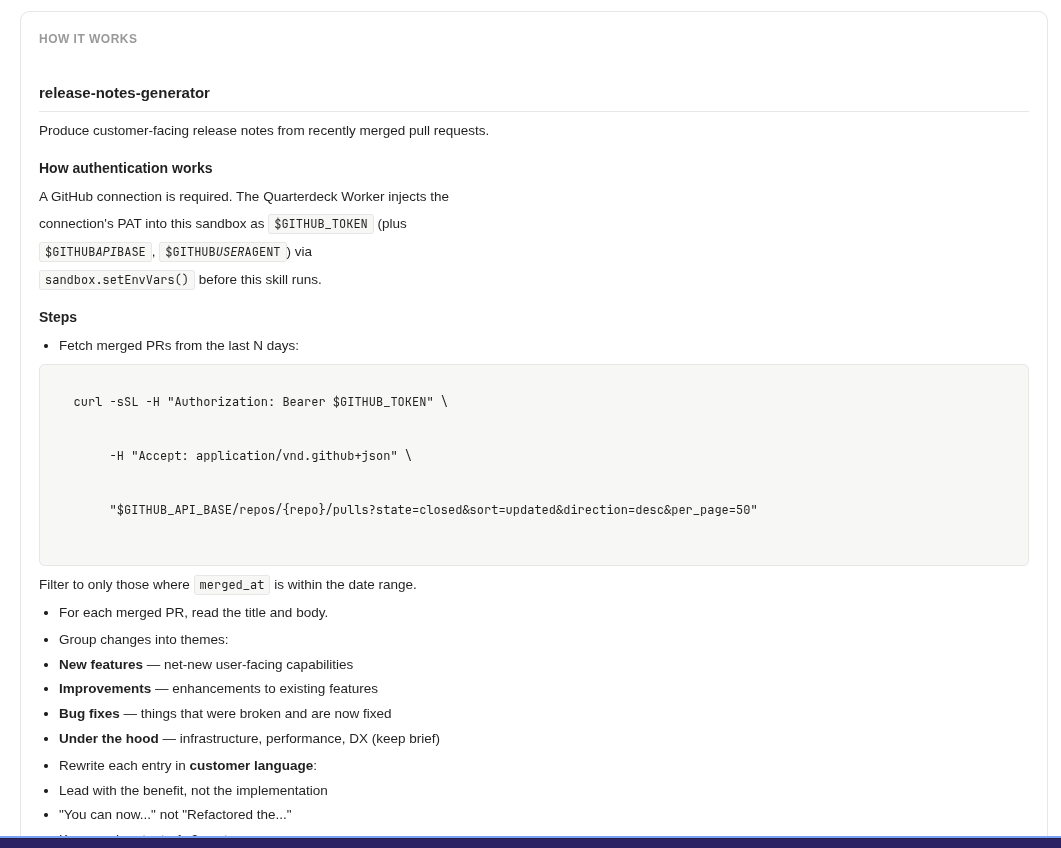
Users can connect the apps they use using Connected Apps.
Easily setup recurring automation’s using scheduling.
What’s cool is you can combine Skills and Connected Apps
I built it entirely on the Cloudflare stack, using their Agents and Sandbox SDKs. It’s rough, but it does work, and you can see that this is so clearly going to become an important piece of the enterprise-AI puzzle. I’ve written before about this idea that true AI productivity gains are likely driven by a tiny group in most organisations and that they need systems, and I think something like this is the right set of core primitives: Skills, Agents, Connected Apps and Artifacts.
I’m not going to go any further with this because I already have a startup, and there at on of great companies solving for this “properly” (Runtime being a great example out of the latest YC batch) but nevertheless, it was a great way to better understand the emerging tool-chain and think more deeply about the core primitives and concepts in this space which is going to be coming increasingly important.
In most teams I’ve ever seen up close, people reinvent the wheel constantly. Grunt and glue work that could be automated isn’t, and process documentation is outdated and often ignored. Building an “agentic organisation” is a way out of this. It won’t be easy to get there (old habits and all that), but there is a path.