Beware the SaaS graveyard

There’s a lot of chatter in our community about what AI means for SaaS. Will we buy more SaaS, or less SaaS? Will we pay more or less? How many apps will we need?
I think this framing below from Carl Rivera (Chief Design Officer at Shopify) is directionally correct. In short, we’ll continue to buy deep and well-designed “solutions”, but we’ll increasingly roll our own software for less mission-critical needs.
Put another way, we’ll buy solutions but make our own tools.
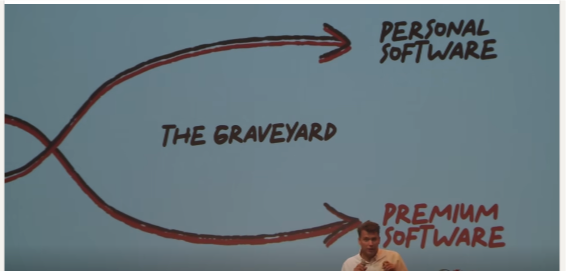
I’m already seeing this in my day to day. We’ve moved a lot of our internal tooling to homegrown. We’ve rolled out own customer health dashboard and we have our own backlog management grooming tool too. On a personal note, I’m building tons of personal software, “just for me”, “just how I like it”. I only expect this to continue.
At the same time, with Komo, the product I work on, we’re seeing more and more traction and demand from enterprise customers. This is because, whilst many customers are (increasingly thanks to AI) happy to maintain internal tools and software for less important workflows, they are willing to pay a significant premium for deep and well-designed solutions that solve key problems. That’s where we play.
“Hasn’t this always been the case?”, you may ask. To which I’d say yes, but what’s happening now is two new forces simultaneously:
The build vs buy equation is actually starting to flip. It’s getting far more viable to build and maintain your own tools. This is an unbelievably big deal.
As a result, the bar for what’s considered “premium software” is being raised fairly significantly. Premium software has to be deep enough (and well considered enough) that it cannot be vibe coded in a few weeks.
What I think this means is that the golden era of the point-solution is over. This doesn’t mean they won’t exist, and that great businesses won’t be built here, but the golden era is over. When I got started in tech, around 15 years ago, all the talk was about the end of monolithic platforms. Thanks to the magic of APIs, we’d all build our own unicorn-tech-stacks, with exactly the tools we wanted, and we’ll just all play nicely together in the same sandbox. This kinda worked (the average SaaS company has like 50+ apps or something crazy today), but recently we’ve seen a shift back to platforms.
Why? I think the main reason is that almost all point-solutions continued to raise prices. This means a slim (albeit great) app that does one little thing, now suddenly may cost $10,000+ a year. It’s totally reasonable to pay $250,000 for a solution (say a CRM or ERP), but it feels less reasonable to pay $10,000 for a tool, precisely because you need so many of them, many of them overlap, and don’t work together. Again, the build vs buy equation is starting to change, for tools that is.
This leaves us with what Carl describes as “the graveyard”. Carls’ drawing above describes perfectly what I think is going to happen in the SaaS market. Enterprise will continue to flourish and grow, and teams and individuals will start to build more personal software for themselves, and anything in the middle is going to struggle big time.
Mid-market solutions will rush to build out deeper, enterprise solutions which will drive more competitive markets (good for customers), but I think there’s little doubt that a lot of SaaS products will disappear, or at least get eaten up by bigger platform plays.
This shift away from point solutions and back to platforms (remember Jim Barksdale’s famous quote “there are only two ways to make money in tech, bundling and unbundling”, and it all works in a cycle), that offer depth, had already been happening prior to AI (Rippling being the best example, they call it “compound startups”), but AI, and in particular AI coding agents are accelerating this trend.
The counterintuitive thing here is that whilst it’s never been easier to build tools, it’s never been a better time to sell a solution. Beware the graveyard!